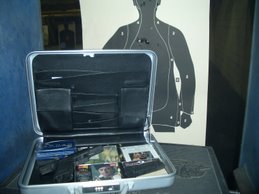
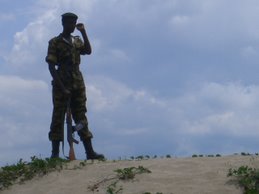
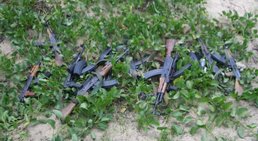
Yes, it’s true, I do love opera and it makes me cry. Just don’t tell my war pals. I would lose all jungle-cred. You see, my line of work frowns upon opera, ballet and other frou-frou pastimes. What is my line of work? Well, to put it simply, I am a security contractor who provides specialty skills internationally to advance the interests of my clients. It involves exotic travel, tropical diseases, interesting people, and some risk. Having served in the public sector and then the private sector for many years, I thought I would lay down the Kalashnikov and pursue what really makes my heart beat: opera.
Forget the firefights or raising armies in foreign lands that no one can find on maps, even with a college education. When you talk about excitement you’re talking Verdi. In fact one of my all time favorite operas – and the title of my meager blog – is about mercenaries: 'La Forza del Destino.' It means “The Force of Destiny,” which pretty much sums up Italian opera in the 19th Century. It involves love, family, a curse, guns, revenge, war, God, and twisted fate. As Maria belts out in 'The Sound of Music' (ahem –NOT opera), “These are a few of my favorite things.”
Ok, first a point of clarification. For all you pro-Westphalian weenies out there who object to the use of private militaries, get over it. Countries have been outsourcing war much longer than not, including the US in WWII. Let’s not get detained with high-falutin’ notions of sovereignty, human rights or any other legal fictions that brief well at the UN but look rather messy in practice.
Sorry, but I had to get that off my chest at the beginning.
Now, back to Forza. It has the best sword fight of any opera. It’s a long and convoluted story that would put “Days of Our Lives” to shame. Two sworn enemies – enemies only through cruel twists of fate – chase each other all over Spain and Italy, but – get this – they don’t actually know what the other looks like (which is SOOOO opera). As a result, they coincidently join the same band of mercenaries and become fast friends, saving each other’s lives, and thus invoking the Sacred War Buddies Bond.

But even sacred bonds can be broken in 19th century Italian opera, where everything is on the betting table. Soon, again through strange fate, they learn the other’s identity and the chase resumes. Don Alvaro decides he’s had enough with fate and checks into the local monastery to live out the rest of his days in nonviolent celibacy. [Blog footnote: his scorned Ex, whom he is still in love with and she with him, is also checked into the same monastery, but they don’t know that yet.] However, clever Don Carlo tracks him down after five years on the road, and shows up to deliver justice, Olde World style.
The climatic scene begins with Don Carlo being rung into the monastery by the world’s grumpiest monk, Melitone (as in melatonin), and surprises the dickens out of Don Alvaro, calling him a half-breed, no-good, hypocritical monk moron. Noble Don Alvaro tries to invoke his newfound faith in God, and Verdi accompanies his prayer with a most sympathetic orchestra. He makes an impassioned plea for peace and the cessation of senselessness violence. Simultaneously, which it he beauty of opera, Don Carlo makes an impassioned plea for honor. Together, in a strange duet of enemies, they harmonize the principles of mercy verses justice (Myers Briggs fans eat your hearts out).
However, who can withstand the insult of being called a mulatto?! Don Alvaro can stand it no more and grabs up the swords thrown at him in by Don Carlo, tosses off the monk robes, and with much operatic shouting, steel meets steels and the duel begins, to an ironically triumphant orchestra. Verdi kicks ass at climaxes. As they say in the movie “Highlander,” there can only be one. And so there is.
To get the whole scene, go to Act IV and start with the duet “Invano Alvaro” [trans. ‘in vain, Alvaro’]. It starts with Don Carlo in the monastery, awaiting Don Alvaro. He is gloating over his victory in finding Don Alvaro, and basically spits on his reputation.
[NEW FEATURE!!!] Listen to the Gardelli version of the climactic scene:
I recommend one of THREE recordings for Verdi’s 'La Forza del Destino.'
The first and all-around best is conducted by
Gardelli, a much under-rated conductor. He times the tempi with a superlative baton, and squeezes every dramatic ounce out of this most dramatic score. Cappuccilli sings a dark and menacing Don Carlo, obsessed with his quarry. Raimondi is the golden-toned Don Alvaro, and he is clearly emotionally invested in the part. Best of all, it ends with the unmistakable metallic clang of rapier on rapier for the dual. How I love the sound of metal in the morning!

The second great recording is James
Levine's early 1960's version, when he was still an unknown upstart. It has a dream cast of the indefatigable Domingo as Don Alvaro, Milnes as a menacing Don Carlo, and the angelic Leontyne Price as Donna Leonora (remember that scorned Ex?), with the London Symphony Orchestra. It's a taut climax scene, and it can be found on RCA recording (RCD3-1864) or on Amazon (its Amazon Standard Identification Number (ASIN) is B000009NIX).

For those who want to walk on the wild side, try
Verdi’s original 1862 version used for the St. Petersburg grand premier. He was originally commissioned to write the opera for St. Pete’s literati. He detested living in Russia for a year (there is a great picture of him bundled in hides and furs), imported tons of Italian sausages to gnaw on, and stretched the limits of the Italian language to express his displeasure (which makes sense, if you too grew up in Italy). Anyway, there is a great recording of the seldom-heard original on the enterprising Opera Rara label (ASIN: B00095L924).

 Portrait of Gertrude Stein by Pablo Picasso, 1906
 One of my favorite places: the grand necropolis, Père Lachaise Cemetery, in Paris.
 The late, great Ms. Stein.